

Listen While You Read
Please listen to Chopin’s first piano composition which was inspired by Wolfgang Amadeuas Mozart. The composition is entitled “Variations on Mozart’s ‘Là ci darem la mano’” from Mozart’s opera Don Giovanni”.
A Fascination for Mozart
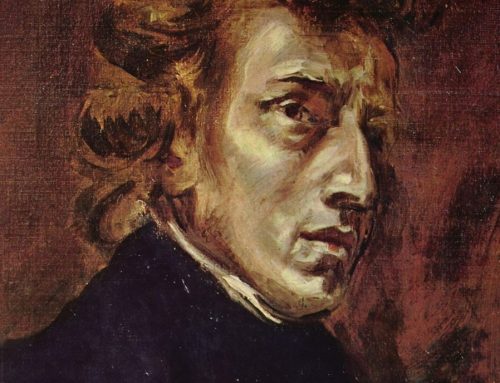
This story focuses on the young Fryderyk Chopin (1810-1849). The portrait above was painted in 1820 when he was 10 years of age.
He was a child prodigy who started composing music at the age of 7, gave his first public concerto performance at the age of 8.
“Variations on Mozart’s ‘La ci darum la mano” was written when Chopin was 17. While he had composed many other works during his childhood, this was the first piece which was sent to a publisher.
We know from his letters that he considered Mozart “the apotheosis of music”. So it is not surprising that the first composition he would introduce to the world, and the last piece which would be played at his funeral, would both be Mozart’s.
This Piece Was Dedicated To His Lifelong Friend Tytus
The title page of the composition (shown right) was dedicated to his best friend Tytus Wojeckowski, who graciously accepted the dedication by writing “J’accept avec plaisir” (I accept with pleasure) which is shown on the right side of the page.
Chopin had a small circle of Polish friends, some of whom studied with him at the Warsaw Conservatory and others who were boarders at his parent’s home. In addition to Tytus, he remained in close touch with Jan Bialoblocki, Jan Matuszynski and Julian Fontana. Within that circle, Tytus was his confidante and someone that he admired throughout his life.

Title Page Of “Variations” in Chopin’s Handwriting

Chopin Age 19 in Vienna
The First Performance in Vienna Was A Resounding Success
In 1829 when, after completing his musical studies in Warsaw, he made his debut as a piano soloist in Vienna, Austria at the Vienna Karntnertortheater. He played the piece that you are listening to. It was actually written for piano and orchestra, but Chopin often played “the variations” without accompaniment. In his mind, the orchestra only served as an accompaniment to a beautiful piano piece.
It received very positive audience and critical acclaim. Writing to his parents in Warsaw about his success, he said that “Everyone clapped so loudly after each variation that I had difficulty hearing the orchestral tutti.”
A Glowing Review From Fellow Composer Schumann
Robert Schumann was the same age as Chopin. He was a German composer, pianist and influential music critic. Like Chopin, he is regarded as one of the great composers of the Romantic era.
Chopin’s “Variations on Mozart’s ‘La ci darum la mano” prompted Robert Schumann to write the famous line “Hats off, gentleman, a genius”, when reviewing the piece in 1831 in the respected Viennese journal “Allgemeine Musikalische Zeitung”.
Schumann went on to describe how the music inspired him, so much so that he was able to imagine entire scenes playing out between the characters in the Don Giovanni opera.

Robert Schumann (1810-1856)

Chopin’s Surprising Response To the Review
So, it is somewhat shocking to read Chopin’s mocking response to this wonderful review in a letter to Tytus.
He wrote: “After lengthy preliminaries, he – the ‘certain German’ – makes an analysis of the piece, phrase by phrase, explaining that these are not like other variations but a sort of fantastically evocative picture. Speaking of the second variation, he says that in this, Don Juan gathers Zerlina in his arms…and finally in the fifth bar of the Adagio Zerlina allows Don Juan to embrace her on a D flat. Plater asked me yesterday the precise spot in her anatomy where this D Flat is to be found!”
Apparently, rather than being grateful for a positive review, the young (and thus far undiscovered) composer satirizes Schumann’s overzealous, romantic interpretation of his music.
Chopin Disdained Others’ Interpretation of His Work
Chopin rarely spoke about the inspiration for his music; each piece was the reflection of a private experience or emotion. And he definitely despised “promotion” of any kind.
In several of his letters Chopin complained bitterly to his copyist Julian Fontana about people who attached their own interpretations to his works.
For example, one of his publishers in England was particularly creative in attaching descriptive names to pieces that he was promoting to the public to make them more interesting. His nocturnes were given names such as “Il Lamento”, “La Consolazine” and “Les Soupirs” (Sighs); the Ballade in F Minor was titled “La Gracieuse”; and the Scherzo in B Flat Minor was given the lofty title of “La Mediation”.
One has to have a little sympathy for the publishers who were dealing with a music world in which titles were formally listed by the type of composition (“etude”, “prelude”, “nocturne”, etc.), the key in which it is played, and a number based on the chronological order in which it was written. And yet, one can understand Chopin’s frustration with others trying to give their own labels to his creations.
Chopin did make one exception, however; he did not seem to mind when his French friends gave his “Étude Op. 10, No. 3 in E Major” the name “Tristesse”, which means “sadness” in French. Chopin said to his German pupil and copyist Adolph Gutmann that he “had never in his life written another such beautiful melody (‘chant‘)”.
Listen to this lovely piece and you will understand why the name “Tristesse” has stood the test of time.




Leave a Reply